Hackathon for students, Sibiu, Romania, 20th of May 2026

Fostering Entrepreneurship through Freelancing Hackathon
Satellite event of ICDD 2026 – LBUS, Sibiu
Overview
Fostering Entrepreneurship through Freelancing Hackathon is an applied innovation initiative organized as a satellite activity of the International Conference on Applied Informatics – “ Imagination Creativity, Design, Development “(ICDD 2026, https://conferences.ulbsibiu.ro/icdd/2026/), hosted by Lucian Blaga University of Sibiu (LBUS). It combines a focused hackathon-style working session with complementary activities integrated into the ICDD conference program.
Although referred to as a hackathon, the event is not a traditional coding competition. Instead, it is designed as a multidisciplinary project-based innovation sprint, focused on freelancing and entrepreneurship. The present call is open for digital applications or concepts that promote a city as an attractive base for Gen Z freelancers. The event combines:
- digital thinking,
- business modeling,
- branding and self-promotion,
- user-centered design and validation.
Sibiu and other participating cities are treated as living laboratories, while solutions are expected to be generalizable and transferable
Thematic Focus: Concept for promoting Your City for Gen-z freelancers.
Breaking news from the future of work: laptops are open, notifications are buzzing, and Gen Z freelancers are making moves. Work is no longer tied to offices, careers are no longer tied to employers, and cities are no longer just places to live — they are ecosystems. For Gen Z freelancers, choosing a city is about more than rent and Wi-Fi. It’s about values, vibes, visibility, and voice.
City authorities around the world have launched a bold challenge: attracting the generation that grew up online, works globally, and refuses to separate life from work. They are looking for ideas that speak the Gen Z language — authentic, inclusive, flexible, digital-first, and community-driven. No corporate clichés. No fake “cool.” Just real solutions for a new way of working.
You are not a student in this story. You are a Gen Z freelancer competing on a global market. You build your personal brand, manage multiple income streams, work from cafés, coworking, bedrooms, and beaches, and choose cities the same way you choose platforms — fast, critically, and emotionally. Your task is to build a digital application (not only software) that helps city authorities attract Gen Z freelancers to choose Your city as a base.
The competition is open, and any city may join the race 😊
This challenge is more than a competition. Participation guarantees real personal development, not just pitch.
Learning & Development Component
Every participant will:
- build self-awareness by filling in professional competency assessment tools, identifying strengths, gaps, and growth potential
- prepare like real freelancers by taking part in curated MOOC courses, gaining practical knowledge before jumping into the challenge
- receive a personalized competence profile — a digital snapshot of skills, achievements, and progress — that also serves as a certificate they can use in portfolios, LinkedIn profiles, and future freelance work
In other words: you don’t just compete — you level up.
Challenge Brief: Designing for the Freelance City
Your task is to build a digital application that convinces city authorities their city can be a preferred base for Gen Z freelancers.
This is freelancing competence in action — creativity, problem-solving, independence, digital skills, and global thinking.
The application should help freelancers choose where to live and work — whether physically or remotely — by making it easier to arrive, connect, work efficiently, and feel included in the local ecosystem. Your concept should reflect what Gen Z freelancers value: flexibility, community, visibility, opportunity, and purpose.
City authorities are not simply selecting a project. They are choosing how their city will position itself in the next decade of work. The winning concept presents a city as more than a location — it becomes a platform that attracts and supports independent professionals.
Beside the digital application, your final deliverable is a presentation in a Pecha Kucha mode (20 slides, 20 seconds each): one visual story, one clear message, one convincing pitch. It must present your application or concept, promote your chosen city, and demonstrate that you understand how freelancers think, work, learn, and decide where to base themselves.
This challenge simulates the real freelance economy — combining real skills, real decision-making, and real value for your future professional path.
Where will the next generation build their base — and their competences?
Multidisciplinary Teams
Teams may include students and young professionals from a wide range of fields, including:
- Computer Science / Informatics
- Business Informatics
- Economics, Management, Marketing, Tourism, and related areas
Projects are not required to result in a fully developed software product or a working application. Strong concepts with limited technical implementation are welcome, provided that the project clearly demonstrates:
- a clear value proposition,
- an entrepreneurial or freelance-oriented mindset, and
- a coherent concept that could realistically be implemented in practice.
Projects that include an IT or computational component are encouraged, as digital solutions naturally support the challenge objective and offer additional opportunities for further development. Selected projects with a stronger technical and computational contribution may also be extended into scientific work and presented or submitted as papers at the ICDD 2026 conference.
Types of Projects
Projects may include, but are not limited to:
• Digital projects
Web platforms, mobile-friendly applications, or digital tools designed to support Gen Z freelancers in choosing and engaging with cities.
• Service and business concepts
Freelance networks, experience design, monetization strategies, operational workflows, or ecosystem concepts supporting freelance activity.
• Branding and promotion projects
Personal or team branding as freelancers, storytelling concepts, social media strategies, and content creation plans aimed at promoting cities to freelancers.
• Hybrid projects
Concepts combining a minimal to medium digital prototype with strong business, branding, validation, or user-experience components.
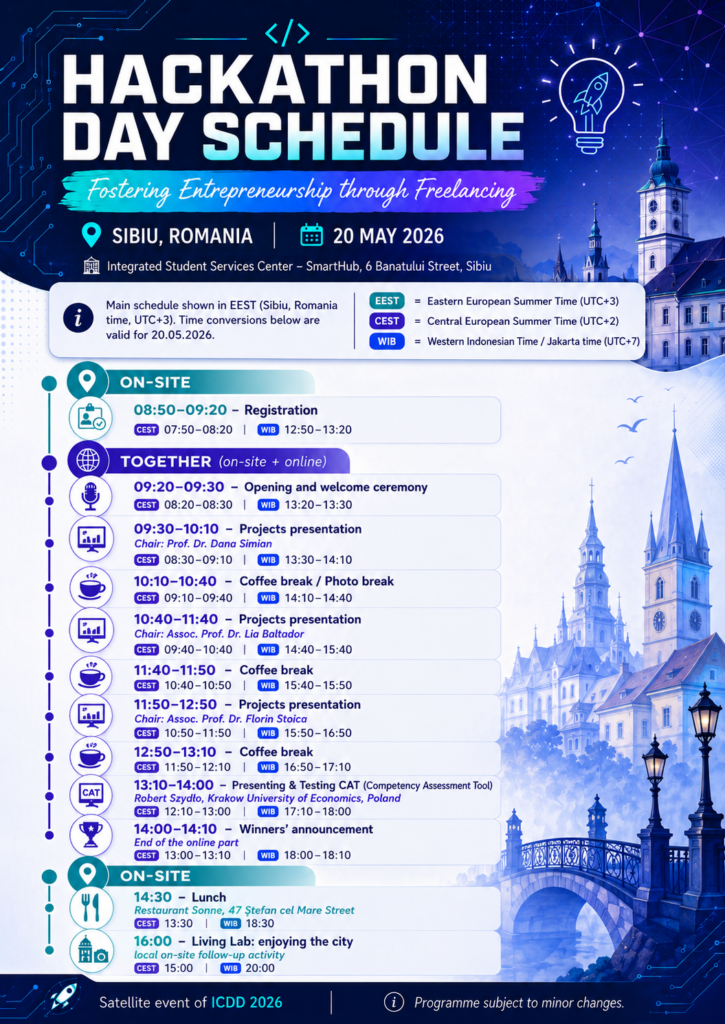
Frame plan of the Hackathon Day
The hackathon will take place over one intensive day and will include:
- Welcoming the participants
- G2KEO – Get to know each other session
- Gathering conclusions from Living Lab activities
- Presentation & evaluation
Projects are presented to a mixed jury (academic + industry-oriented).
Connection to ICDD 2026
Participants may optionally extend their hackathon projects into academic contributions:
- Projects incorporating a computational or digital component may provide a natural basis for extension into a scientific contribution and submission to ICDD 2026, subject to the conference’s standard review process and submission conditions.
- Authors must be registered both for the hackathon and the conference.
Call for Applications
We invite students and young professionals to apply for the Fostering Entrepreneurship through Freelancing Hackathon, an interdisciplinary innovation event focused on freelancing and entrepreneurship, organized as a satellite event of ICDD 2026.
Who should apply?
We welcome:
- motivated participants interested in freelancing and entrepreneurship,
- multidisciplinary teams or individual,
- project ideas related to tourism, digital services, branding, or business innovation.
Projects may include digital solutions, business concepts, branding strategies, or hybrid approaches.
Opportunities
- Develop and validate a real-world project
- Learn and apply design thinking methods
- Gain visibility within the ICDD 2026 community
- Optional project extension into a scientific contribution for submission to ICDD 2026
- Certificate of participation for active participation (with presentation)
Important Dates
- Application deadline for Hackathon: 05 May 2026
- Application deadline for ICDD: 05 April 2026
- Teamwork: till the 19th of May 2026
- Submission of the final work: 18 May 2026;
Please send presentations in pdf format to Robert Szydło szydlor@uek.krakow.pl - Hackathon day: 20 May 2026
- ICDD conference 21 – 23 May 2026